
Evolving Beyond Nationalism
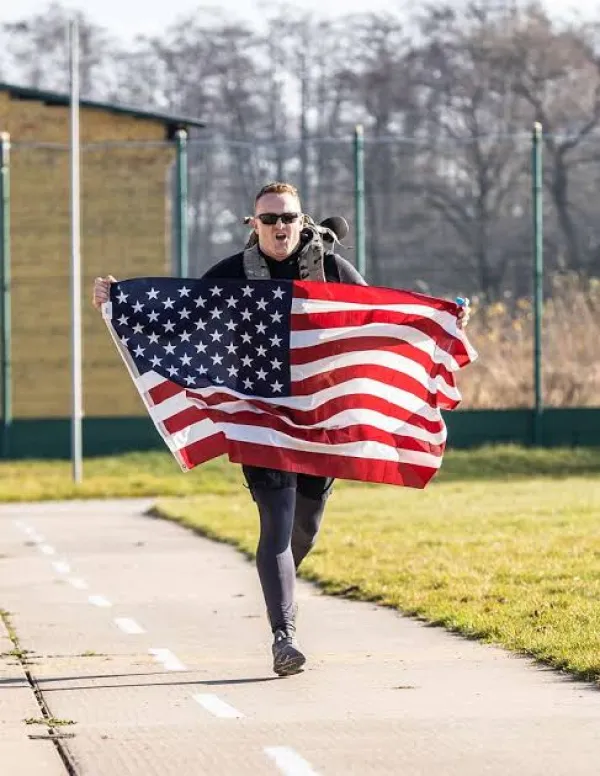
1Lt. Clayton Carroll holds the American flag. NARA & DVIDS Public Domain Archive
“Nation” equals identity. I’m an American! Hurray!
It’s almost embarrassing to confess this, but yeah, that’s me (or used to be me), sitting back in my easy chair, waving a flag. My “nationality” is such a profound, lifelong part of who I am I rarely actually questioned it. At best I shrugged, then momentarily glared in anger at . . . the government, the media, whoever. Why do we have a trillion-dollar military budget, or a president who wants to up it to one point five trillion? Why do we always have an enemy or two or three, who isn’t as human as we are and must be defeated, or at least arrested?
At least being an American comes with a fair amount of rights – freedom of speech, freedom to question authority, and so-o-o much more – and usually I embrace those rights with a sense of hope that the future will be saner. But that sense of hope has been ebbing lately. I have come to realize over the years that I am no longer just an American. I’m a citizen of Planet Earth.
I say this with a sense of paradox. I love the life this nation has given me, and value much of what it claims to stand for, but I think it’s time for humanity to reach beyond nationalism and borders and connect with a larger god – a larger global organizing principle. And I do not claim that this will be simple or obvious.
But it’s time. “Nation” equals war. It equals “get outa here!” The more power it has, the more it sustains itself with the worst of who we are. This means it always needs an enemy . . . or two, or three, or fifty thousand.
And our enemy becomes the norm. Here’s where I truly lose hope that the human race can survive nationalism. We dehumanize our enemies, which gives us “permission” to kill them: to shatter their social structure, to erase them from existence. Ho hum.
For instance, here’s a quickie ICE update from ABC News the other day:
“U.S. Immigration and Customs Enforcement (ICE) arrested 51,000 individuals in July, according to sources familiar with the data. The arrests are the largest in a single month in DHS history. . . .”
And guess what?
“Those being detained in some cases do not have criminal records and have valid work authorization or parole documents. . .”
And what does the phrase “in some cases” mean? Maybe a dozen of the arrestees were good guys? That’s what it sounds like, as you give the story a read. After all, remember Donald Trump’s words back in 2015: “When Mexico sends its people, they’re not sending their best. . . . They’re sending people that have lots of problems, and they’re bringing those problems with us. They’re bringing drugs. They’re bringing crime. They’re rapists. And some, I assume, are good people”
But all of them are aliens! They’re illegals (even if they’re not). They’re wrecking our country. They need to go.
And then, of course, there are the wars going on around the world, wreaking death and hell and genocide: Israel’s bombing of Palestine has killed over 73,000 people at this point, with more than 173,200 wounded. As PBS points out, over 1,000 people have been killed in Gaza since the start of the so-called “ceasefire.” And, my God, the death and casualty toll in the Ukraine war, on both sides, is approaching 2 million people over these last four years.
This is just part of it. The global military expenditures in 2025 were 2.9 trillion dollars, a total that’s been increasing every year for the last eleven years. As Connie Peck, founder of the United Nations Institute for Training and Research Programme in Peacemaking and Conflict Prevention, wrote: “If similar increases continue, and NATO countries enlarge their expenditure to 5 percent as pledged, global military spending could reach 6.6 trillion by 2035 – five times the level at the end of the Cold War.”
In other words, it’s getting worse. The more “they” spend, the more we have to spend. And the only way the world’s nations are safe from one another is by “mutually assured destruction”: a concept that, with the emergence of nuclear weapons, means the threat of planetary annihilation. I think it’s time to evolve beyond nationalism, which is not based on valuing life. It’s based on “winning.”
Peck writes: “Do we really want or need more weapons and more wars? Shouldn’t we, instead, choose cooperative security, collective security, and human security, as represented by the United Nations?”
Let’s stash our cynicism and, as Peck writes, begin addressing the root causes of conflict. We are capable of looking beyond ourselves. She quotes from the UN Charter Preamble. Here are the words from the Preamble that pierced me most deeply, as I imagined them helping to create a new form of government:
“We the peoples of the United Nations (have) determined to save succeeding generations from the scourge of war . . . and to reaffirm faith in fundamental human rights, in the dignity and worth of the human person. . .”